
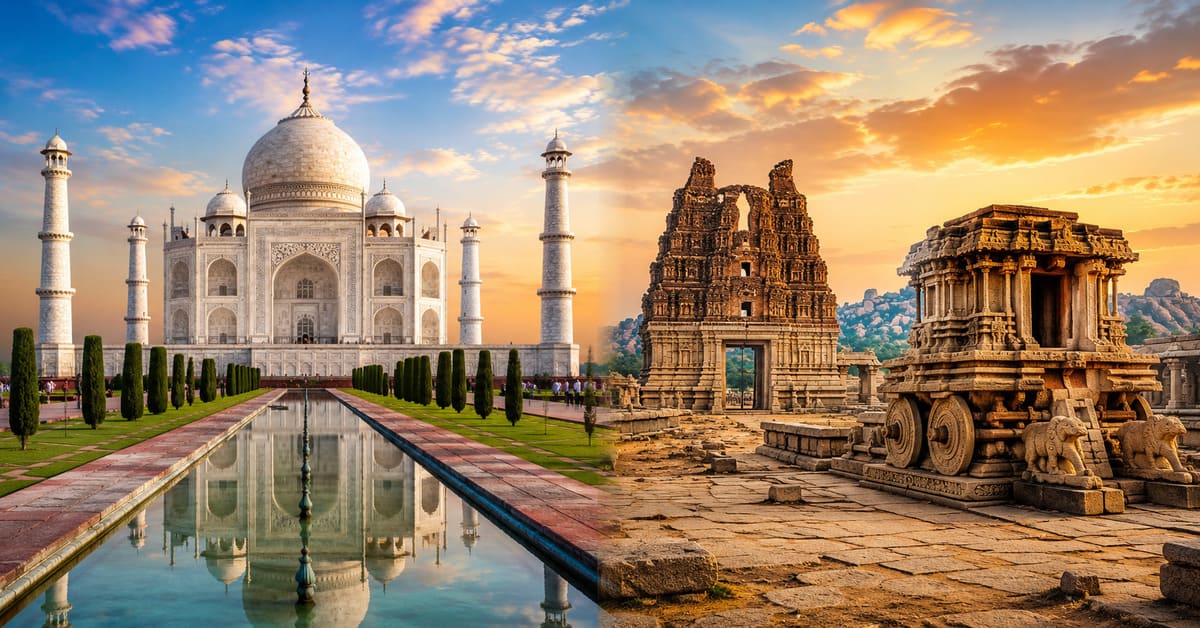
My visit to Taj Mahal and Hampi Ruins
Taj Mahal
Taj Mahal is an ivory – white marble mausoleum in Agra district of Uttar Pradesh in India. It was built between 1632 – 1653, with the help of the employment of 20, 000 artisans. It was commissioned, around 1631 by the 5th Mughal emperor, Shah Jahan to house the tomb of his beloved wife, named Mumtaz Mahal.
This monument is situated on the south- bank of Yamuna River in Agra province of Uttar Pradesh. The main architect generally credited for building this monument is Ustad Ahmeed- Lahori. It represents the pinnacle of Mughal architecture, blending Persian and Indian style. Its significant characteristics or notable features include the given below.
Structure – The central focus is on a white Marbled tomb on a raised stone plinth.
Inscription- Ancient Quran inscriptions, including detailed Persian inscriptions inscribed on a wall.
Color Change- The monument becomes light pinkish in the morning, white in the evening, golden in the night.
It was declared a UNESCO world heritage site in 1983, named one of the Seven Wonders of the World. Due to pollution, the white color of the Taj Mahal has faded away eventually, into light brown.
The Taj Mahal was a costly construction around 32 million rupees in 1653 which is worth many billions in Today’s money. There are 4 minlets engulfing the Taj Mahal which are slightly titled outwards to deliberate structural fall.
It represents the jewel of Islamic art in India and is considered as monument of enduring love& affection. It is a must – visit place for tourists travelling to India and for those who love to study about history or historical incidents.
Hampi Ruins
Hampi, located in Karnataka in India was the capital of the glorious Vijayanagar empire. Founded by Harihara I and Bukka I, it grew into one of the world’s richest cities from the period between 1509 – 1529 AD, when it was ruled by KrishnadevaRaya. It is constructed on the banks of The Tungabhadra River; established to defend southern India from Delhi sultanates.
The city contained over 1600 structures (not all of them remain, today.) including the famous Virupaksa Temple, Vijaya Vittal Temple with its stone chariot& Lotus Mahal. The picture of the stone chariot in Vittal Temple is depicted in the Indian Currency notes. The city thrived for many years until its fall during the battle of Talikota in 1565 A.D being defeated by Delhi sultanates, subsequently pilled for six months and abandoned.
It is also a historical monument, recommended as an itinerant tourist place in India.
By Arush Dey
Visit our Facebook Page : Little Authors | Facebook
About Author