
My Experience in an Art Integration Exhibition
In this entry, I would like to describe my experience of the Art Integration Exhibition 2026 (12th February) at my school, Father Agnel, Noida (held for Classes VI to VIII).
It was our winter holiday homework for late December, and we had been preparing for it for a month. All classes and sections were given different themes (Grade 8 was given the theme “Sustainable Future: India@2040”).
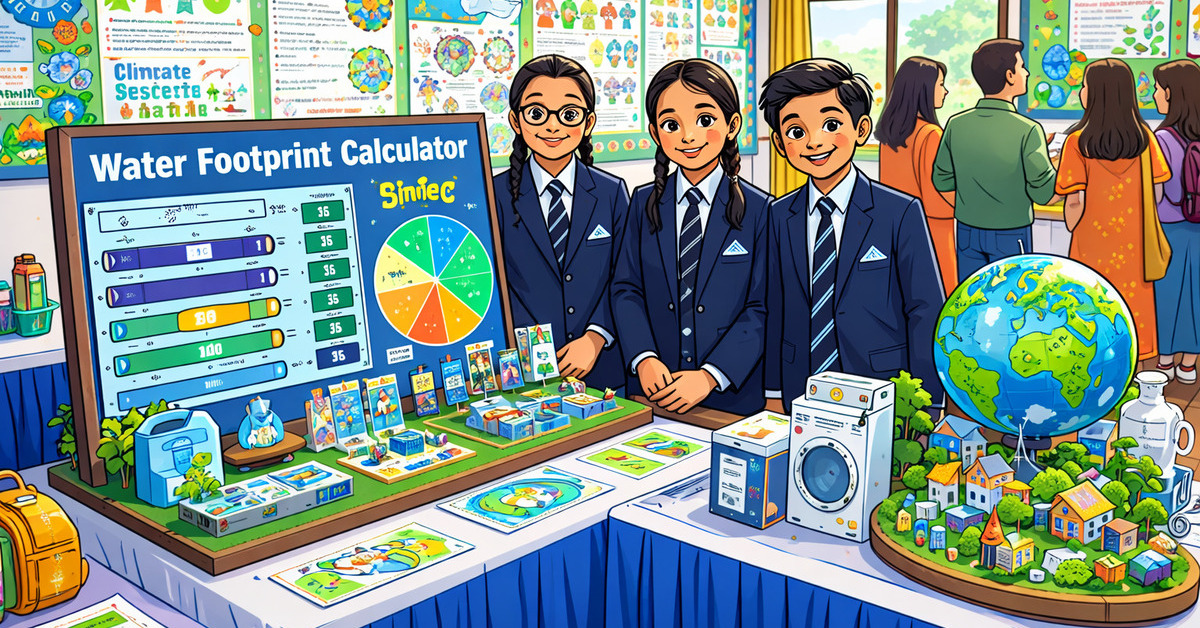
Our class, 8C, had the topic of Water Conservation and Climate Resilience. My teammates, Annika Gupta, Vedanshi, and I were given the subtopic “Water Footprint – Our Daily Lives and Future India.”
We made a model of a Water Footprint Calculator for Science, a Maths pie chart of daily water usage of a household of 3–4 people, an English collage on Hidden/Virtual Water that we don’t see yet indirectly consume, and a poster for SST highlighting the significance of each individual’s contribution to India’s development.
Our presentation: The Water Footprint Calculator operates by adjusting the sliders for household chores and activities to enter the input, using the digit chits to display the values (and vertical addition), along with the total value, which is the person’s direct water footprint (estimated). They can then refer to the output bar to check whether it is sustainable or high.
Water footprint is the amount of water consumed by an individual, a household, or an organization. It can be further divided into two categories: direct and indirect water footprint. Direct water footprint is the water we directly use from our taps, while indirect water footprint is the water we use indirectly. For example, electronics and cotton clothes need a lot of blue water to cool down processing units and grow cotton crops, etc. The use of fertilizers for growing our food and dyeing clothes leads to grey water. The food we consume, and meat require rainwater (green water) to grow crops and water the grass to feed livestock, etc.
In our pie chart, we depicted a sustainable family of 3–4 people’s daily direct water usage, acting as an example of how sustainable amounts of water can be used to meet daily needs.
We made a reference guide to show an estimation of how much water goes into each household activity depending on methods and appliances. There, we compared the model efficiencies of each appliance. For example, a top-loading washing machine takes much more water than a front-loading washing machine.

We concluded by stating that if each individual puts in efforts to reduce their water footprint, it would make a huge collective impact on India. All our classmates and other students across 6th, 7th, and 8th grades had constructed models and made collages, posters, and presentations. Together with our classmates, we decorated the classroom and the board, incorporating all subjects, including French and Hindi.
Although at first we were off to a not-so-great start, with the help of our teachers’ guidance and motivation, we were able to manage it in the end, and it started to look really nice!
They had also made a PPT that was displayed during the exhibition using the projector, featuring all our classmates and their projects on the board.
On exhibition day, after we arranged our desks and projects, parents of all students came to the exhibition.
Personally, it was a really good experience presenting our work and topic to the parents, although there were a few ups and downs. For instance, we got kind of stressed out during an interaction when we weren’t able to talk about a certain concept with complete assurance or answer a cross-question. But at the end of the day, I would say it was a very fruitful result!
The exhibition was a great learning opportunity for all the students, as it helped develop skills like teamwork, creativity, and communication. Moreover, it helped us learn about the issues that need to be worked on in our country. As the youth generation, we realized we need to make better choices for the development of a sustainable India in the near future.
I really enjoyed conducting meetings, group discussions, and team efforts with my group partners.
Overall, the exhibition seemed to be a really nice experience!
Visit our Facebook Page : Little Authors | Facebook
About Author
