
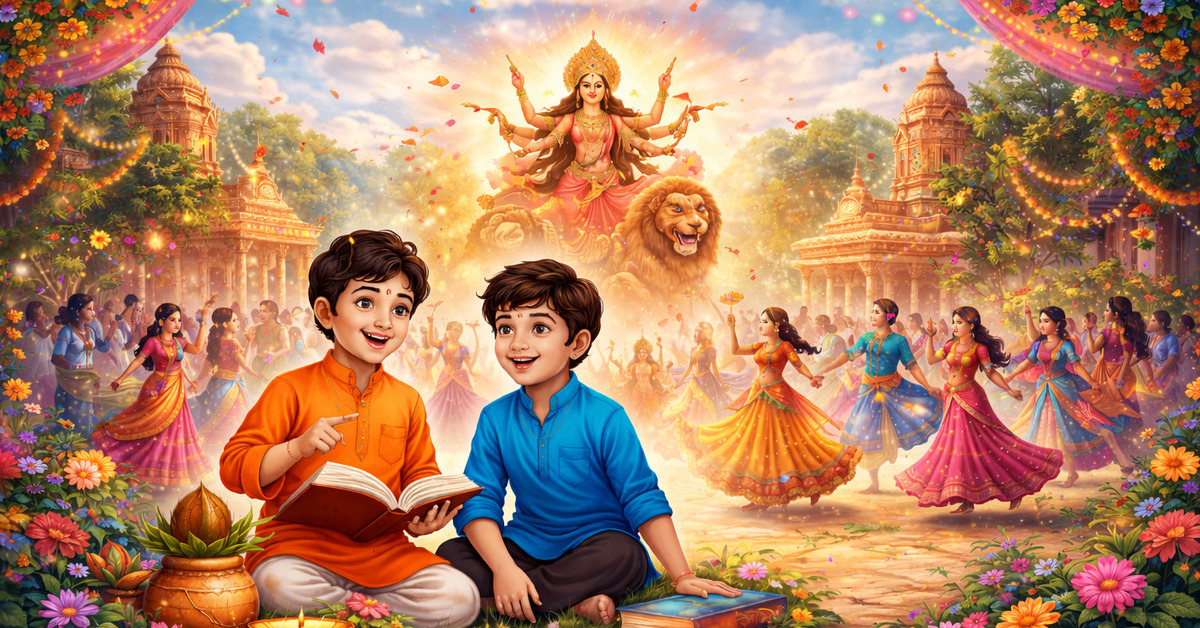
The Story of Navratri
In the beating heart of Navratri, Gujarat, there lived two boys named Shyam and Jitesh. They were best friends, but they had many differences between them.
First, Shyam was an intelligent boy. He had great skills in drawing, cooking, dancing, and many more. He was very helpful, and everybody liked him. However, he did not like to read storybooks; he said they were boring.
On the other hand, Jitesh was not a good student at all. He was very rude and didn’t have any special skills, but he loved books.
One day, Shyam wanted to know about Navratri. He asked Jitesh, who told him to come the next day so he could research about it.
The next day, Shyam came, and Jitesh began explaining. He said that Navratri is a Hindu festival celebrated for nine days and ten nights. It is observed in the Hindu lunar month of Ashvin. It is dedicated to celebrating the victory of Goddess Durga over evil and darkness. It starts with Ghatasthapana and ends with Vijayadashami.
Navratri comes four times a year, but Sharad Navratri is the most widely celebrated. It usually falls in September or October.
The first day is known as Ghatasthapana or Kalash Sthapana. On this day, we place a sacred pot in our homes, symbolizing the arrival of Goddess Durga. It also marks the beginning of Navratri. We pray for her to stay in our homes for the next nine days.
The word “Navratri” itself means nine nights (“Nav” means nine and “Ratri” means nights). The sacred pot represents the universe and cosmic energy. We sow seven types of grains, which symbolize fertility and growth. We also pray for a prosperous and happy year ahead, as the Hindu New Year begins around this time.
For placing the pot, we first prepare a soil bed by spreading clean soil over a tray. Seeds are then spread evenly on the soil. The pot is prepared using clay or dough and filled with water, betel nuts, coins, and durva grass. Five mango or Ashoka leaves are placed on the rim, and a coconut wrapped in red cloth is placed on top.
Devotees chant mantras to invite Goddess Durga to take her seat. This ritual must be performed at an auspicious time. If the morning muhurat is missed, it should be done in the next suitable time. It is strictly prohibited to perform it at night or on Amavasya (new moon day). Once placed, the pot should not be moved until the festival ends.
Goddess Durga has nine forms, and each day is dedicated to one form.
The first day is dedicated to Maa Shailaputri, who represents strength and stability. Devotees offer pure ghee and flowers like jasmine and hibiscus.
In her previous life, she was Sati, the daughter of King Daksha. She fell in love with Lord Shiva, but her father did not approve of the marriage. Despite this, she married Shiva. Later, Daksha organized a grand yajna but did not invite them. When Sati attended, she was insulted and, unable to bear it, sacrificed herself in the fire. She was later reborn as Shailaputri and again married Lord Shiva.
The second day is dedicated to Maa Brahmacharini, who symbolizes devotion and penance. She performed intense meditation and penance for thousands of years to marry Lord Shiva, surviving on leaves, fruits, and eventually only air and water. She was later called Aparna. Impressed by her dedication, all the gods accepted her marriage.
The third day is dedicated to Maa Chandraghanta. She wears a crown and is always ready for battle, with ten hands carrying weapons. She represents peace and protection.
The fourth day is dedicated to Maa Kushmanda, who is known for her radiant smile. It is believed that when she smiled, the universe, including the sun, moon, and stars, was created.
The fifth day is dedicated to Maa Skandamata. She is the mother of Lord Kartikeya, who defeated the demon Tarakasura. She represents power and motherhood.
The sixth day is dedicated to Maa Katyayani, a fierce form of the goddess. She defeated the powerful demon Mahishasura. She was created from the combined energies of Brahma, Vishnu, and Shiva. Armed with divine weapons, she emerged victorious in battle.
The seventh day is dedicated to Maa Kalaratri, the fiercest form of Durga. She destroyed the demon Raktabija, whose blood could create new demons. She prevented his blood from touching the ground, ending his cycle of rebirth.
The eighth day is dedicated to Maa Mahagauri, who represents peace and purity. After intense penance, Lord Shiva cleansed her with holy Ganga water, restoring her radiant form.
The ninth day is dedicated to Maa Siddhidatri, who grants wisdom and powers. She blessed Brahma, Vishnu, and Shiva with divine abilities to create and sustain the universe.
Finally comes Vijayadashami, the day of victory. It marks Lord Rama’s victory over the demon Ravana and Goddess Durga’s victory over Mahishasura. Effigies of Ravana, symbolizing evil traits like lust, anger, greed, pride, jealousy, and ego, are burned on this day.
Shyam listened carefully and noted everything. He understood the significance of Navratri and celebrated it with great joy.
By Darsh Santhaliya
Visit our Facebook Page : Whiskers and Doodles
About Author