
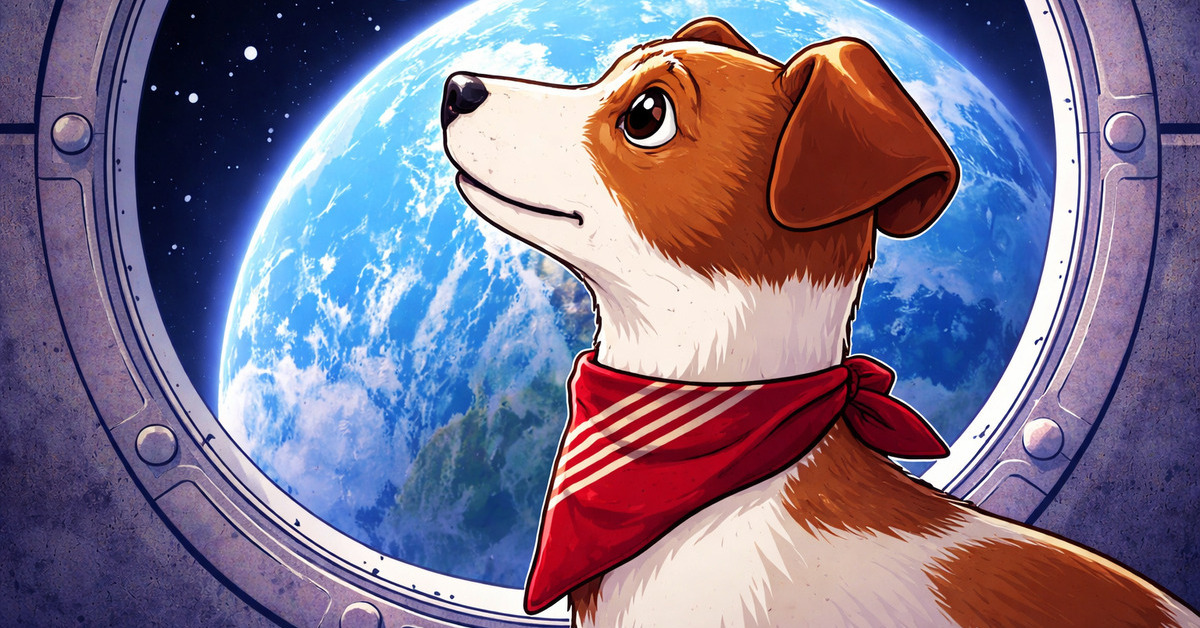
From Streets to Space
Birth and Survival
In 1954, near Moscow, Russia, during the Cold War between Russia and the USA, the race to reach space had just begun.
In a freezing alley lived two stray dogs — a mother and a father. They guarded their small territory carefully, but more than anything, they protected their two tiny twin pups.
The twins did not look alike, but their parents loved them equally.
The mother kept them warm with her body because the temperature outside was –22°C. The father protected the family from strangers and people who might harm them.
When the puppies turned three weeks old, their parents slowly allowed them to search for food. The parents also warned them about the dogcatchers.
One day the parents went to rest while the pups tried to find food by themselves. After searching through the cold streets, they found burnt bread, potato peels, and some old bones. Proudly, they carried the food back to their parents.
Even in such a harsh world, the little family survived together.
Years of Hunger
As time passed, the puppies grew into healthy young dogs. They roamed the streets carefully, learning how to survive without getting caught.
They searched for food, found warm corners to sleep, and even created their own small territory. Most importantly, they learned how to avoid the dog catchers who roamed the city.
At night, before sleeping, they often looked up at the sky.
One night they noticed something strange — a shiny moving star slowly crossing the dark sky. They tried to grab it but they left it.
That glowing object was Sputnik 1, the first satellite launched by humans. The moon shone quietly as the satellite moved across the sky, making soft beeping signals.
Soon the dogs curled up and fell asleep under the cold Russian night.
Kidnapped
In 1957, one morning the two dogs were walking toward the edge of their territory.
Suddenly two men rushed toward them. They were dog catchers.
At that time, scientists were looking for small, calm female dogs for space experiments.
The dogs tried to run away, but the men threw a net over them. Within seconds they were trapped and placed inside a cage.
They tried to escape, scratching and pushing against the bars, but the cage was too strong. Soon they were loaded into a van with other captured dogs.
None of them knew what was about to happen next.
Harsh Training and the Old Candidates
The dogs were taken to a training centre where scientists studied them carefully.
Inside one room, one of the twins noticed two other dogs. Their names were Albina and Mukha.
Albina had already gone on two test flights, while Mukha was used as a control dog for experiments.
One scientist came forward and looked at the younger dog carefully.
He named her “Kudryavka,” which meant “Little Curly.”
Later, she would be known to the world as Laika.
The training was very difficult. The dogs had to stay in tiny cages, spin inside centrifuge machines, and live in small containers for long periods.
Despite all the challenges, Kudryavka passed every test. Finally, she was selected for a mission from which she would never return.
Three days before launch, scientists performed operations on her body and attached sensors to monitor her heartbeat, movement and breathing.
One scientist, Vladimir Yazdovsky, felt very sad for her. Before the launch, he secretly took her home so she could spend one happy day with his children. They squealed in joy on seeing her.
The children played with her happily as she chased a rubber ball across the room.
For a short time, she felt like she had a real home.
But soon, it was time for her to go.
Launch Day
On October 31, 1957, at Baikonur Cosmodrome in Kazakhstan, the spacecraft Sputnik 2 was ready for launch.
Laika was placed inside the small capsule where she would remain for 72 hours before liftoff. Just before closing the hatch, one scientist bent down and gently kissed her nose.
He whispered a quiet goodbye and wished her “Bon voyage.”
He knew she would never come back.
Was It Successful?
On November 3, 1957, at 2:30 AM Moscow time, Sputnik 2 launched into space with powerful roaring engines.
Inside the capsule, Laika was terrified. Her heart rate jumped from 100 beats per minute to 240 beats per minute.
This was a one-way journey. The spacecraft had enough battery power to last about a week.
Scientists even prepared sedatives in her food so she could sleep peacefully later.
They did not want her to suffer.
Heat and Panic
From the small window, Laika could see an incredible view. The Earth looked like a blue marble floating in space.
She completed her first orbit around the planet. But during the second orbit, something went wrong.
The spacecraft’s central system failed to separate properly. Soon the temperature inside the cabin started rising. Laika ran around nervously.
Her paws became hot as the cabin turned warmer and warmer.
By the third orbit, the temperature had become unbearable. The small capsule felt like an oven.
She barked, whined and panted in pain. But millions of kilometres away, no one could help her.
Demise
During the fourth orbit, only a few hours later, the heat became extreme with a fatal degree of 40 degrees Celsius.
Laika was exhausted and weak. Slowly she lay down.
In her final moments, memories seemed to flash in her mind. She remembered her parents protecting her in the cold alley.
She remembered playing with her twin sibling.
She remembered the scientist’s children laughing while she chased the rubber ball.
Her heartbeat slowed down. Her vision slowly faded into darkness.
And finally, the brave little dog quietly passed away.
Lies and Lies
After her death, the truth was not revealed immediately.
The Soviet government told the media that Laika had survived for many days in space.
Later they said she died peacefully after eating sedative food. Some reports claimed she survived four days.
But the real story was hidden.
For many years, the truth remained a mystery.
Re-entry
On April 14, 1958, after 162 days in orbit and 2,570 trips around Earth, Sputnik 2 finally re-entered Earth’s atmosphere.
The spacecraft burned up completely. Laika’s remains were scattered in the atmosphere.
Nothing was left behind. Not even a single grain of ash.
A Secret Revealed and a Statue
After 45 years, in 2002, a scientist named Dmitri Malashenkov finally revealed the truth.
He explained that Laika had died only a few hours after launch due to overheating.
People around the world felt sad when they heard the real story. To honour her bravery, in 2008, a statue of Laika was built in Moscow.
The sculpture was created by Pavel Medvedev with design help from Sergey Pakhomov.
The statue shows a rocket shaped like a hand, with Laika standing proudly on top.
Today, it reminds people of the brave little dog who helped
humans reach space.
And maybe, somewhere among the stars, Laika is still happily barking.
Note from the Author
My name is Aashka Nair and I am 11 years old. Even though I have never visited Russia or seen the rocket in real life, I feel like I know Laika’s story.
One day in Brigade Meadows, Bangalore, I found an article from The Week that talked about the Sun and the Solar System. While reading about Earth, I saw a picture of a dog in space chasing a bone. I became very curious because I love dogs.
So I started reading more about her. That dog was Laika.
At first, I thought fire came inside the spacecraft. Later I learned that she died because the cabin became too hot. Her story made me feel both sad and proud. If Laika were alive today, I would have loved to adopt her and make her a friend for my 5-year-old Spitz dog, Rosie.
Even though she lived long ago, she will always be remembered as a brave little space dog.
By Aashka Nair
Visit our Facebook Page : Little Authors | Facebook
About Author

Hi Aashumanee,
Nice to read your story about dear Laika.
Let us pray that her soul rest in peace.
Do please come up with more stories.
Rosie is fine.
With love
Achachan.
Nice story
Nice story aashu,Keep going by bringing more stories
Good work Aashu 👏