
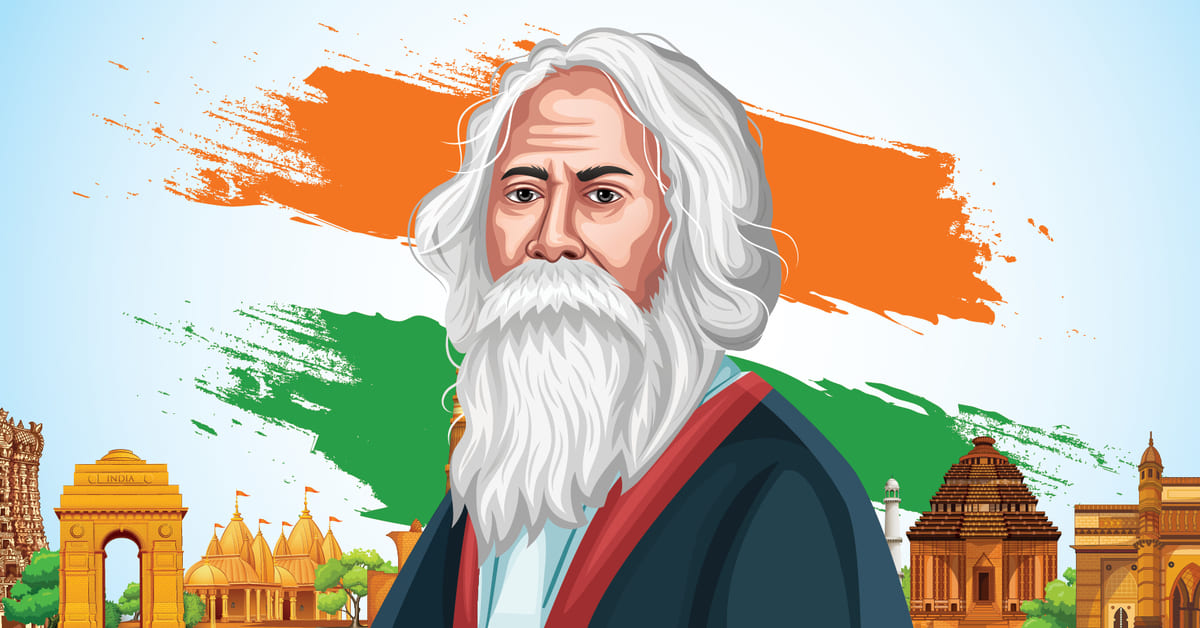
An Analysis of Freedom and Reason in Tagore’s Poetry
Today, I would like to give a critical analysis of a wonderful poem written by Rabindranath Tagore. I think it is perfect for the occasion for which we are all gathered here.
“Where the Mind Is Without Fear” by Rabindranath Tagore.
A few words about the poet—Tagore was a Bengali composer and philosopher, a voice for Indian independence, and the author of our country’s national anthem.
He wrote the poem “Where the Mind Is Without Fear” in the pre-independence era. With the experience of being under colonial rule, he expressed a clear idea of how he wanted India, as a country, to be—ideas that match those of the Constitution, ideas of a free and independent India.
The poem is as follows:
Where the mind is without fear and the head is held high;
Where knowledge is free;
Where the world has not been broken up into fragments
By narrow domestic walls;
Where words come out from the depth of truth;
Where tireless striving stretches its arms towards perfection;
Where the clear stream of reason has not lost its way
Into the dreary desert sand of dead habit;
Where the mind is led forward by thee
Into ever-widening thought and action;
Into that heaven of freedom, my Father, let my country awake.
The poem, full of metaphors, describes a country where there is freedom of expression and where people are confident and respectful of others and themselves, as understood by the line, “Where the mind is without fear and the head is held high.”
“Where knowledge is free” indicates that education is unbiased and flows in all directions, accessible to all.
“Where the world has not been broken up into fragments by narrow domestic walls” refers to a country that is not divided into caste, religion, or race by narrow-minded thinking.
“Where words come out from the depth of truth” represents a country whose people are honest, where justice is served, and where an unbiased media is present.
“Where tireless striving stretches its arms towards perfection” shows people individually putting in tireless efforts and hard work, which collectively aim toward the completion and progress of the country.
“Where the clear stream of reason has not lost its way into the dreary desert sand of dead habit” compares how a stream of water dries up in barren sand where nothing survives. Through this, Tagore expresses a country whose people have not lost their logical reasoning to outdated superstitions or customs that do no good to society.
“Where the mind is led forward by thee into ever-widening thought and action” shows people having faith and being guided by God to implement their ideas through good actions.
In the line, “Into that heaven of freedom, my Father, let my country awake,” Tagore expresses a prayer to God that the country would move ahead in the right direction, on a path to become a blissful space of freedom.
It is a beautiful poem with deep meaning, and it serves as a strong reminder for us on this special day.
I would like to conclude my words by sharing a powerful quote by John F. Kennedy:
“Don’t ask what your country can do for you; ask what you can do for your country.”
Whether it is focusing on waste management at our homes, maintaining civic harmony, or volunteering; as students, being excellent in our studies to shape a better future; or taking part in plantation and cleanliness drives at school—every effort matters.
Most importantly, in these days, we must use social media responsibly and make comments with care.
Every effort makes an impact.
Thank you.
By Maira Mayanaz Hashmi
Visit our Facebook Page : Little Authors | Facebook
About Author